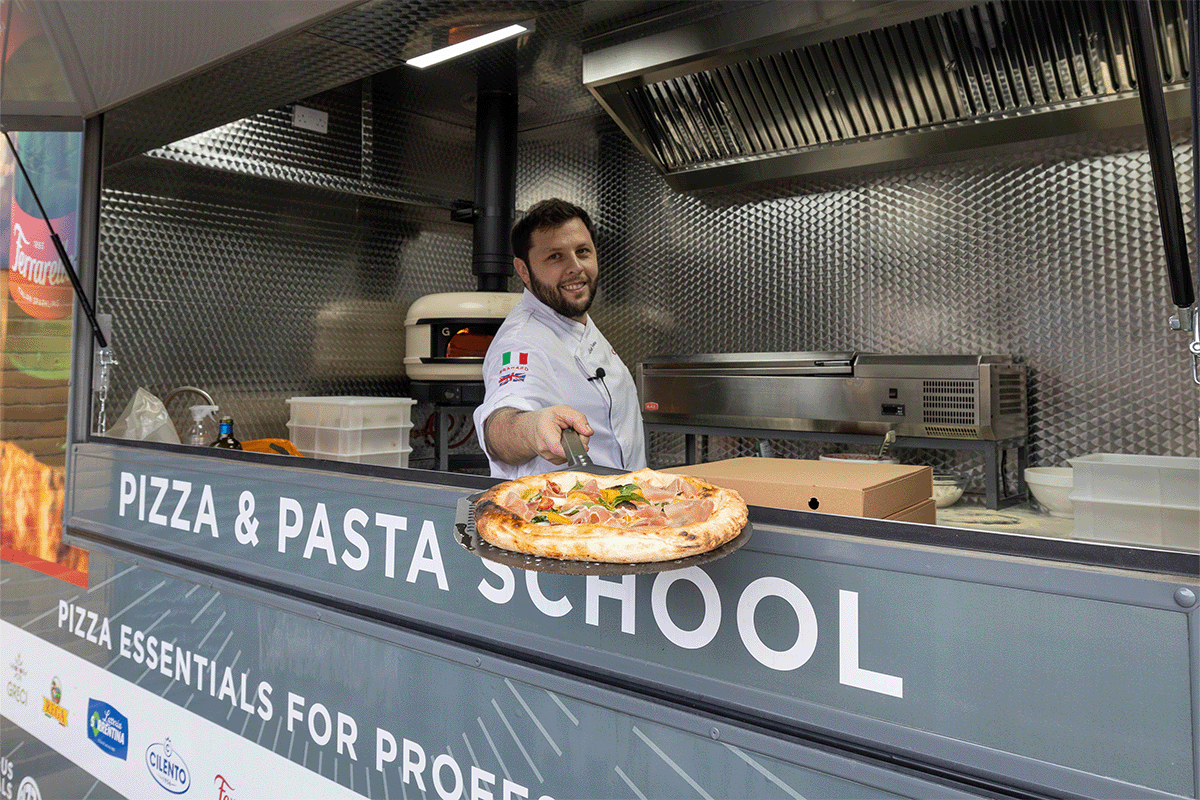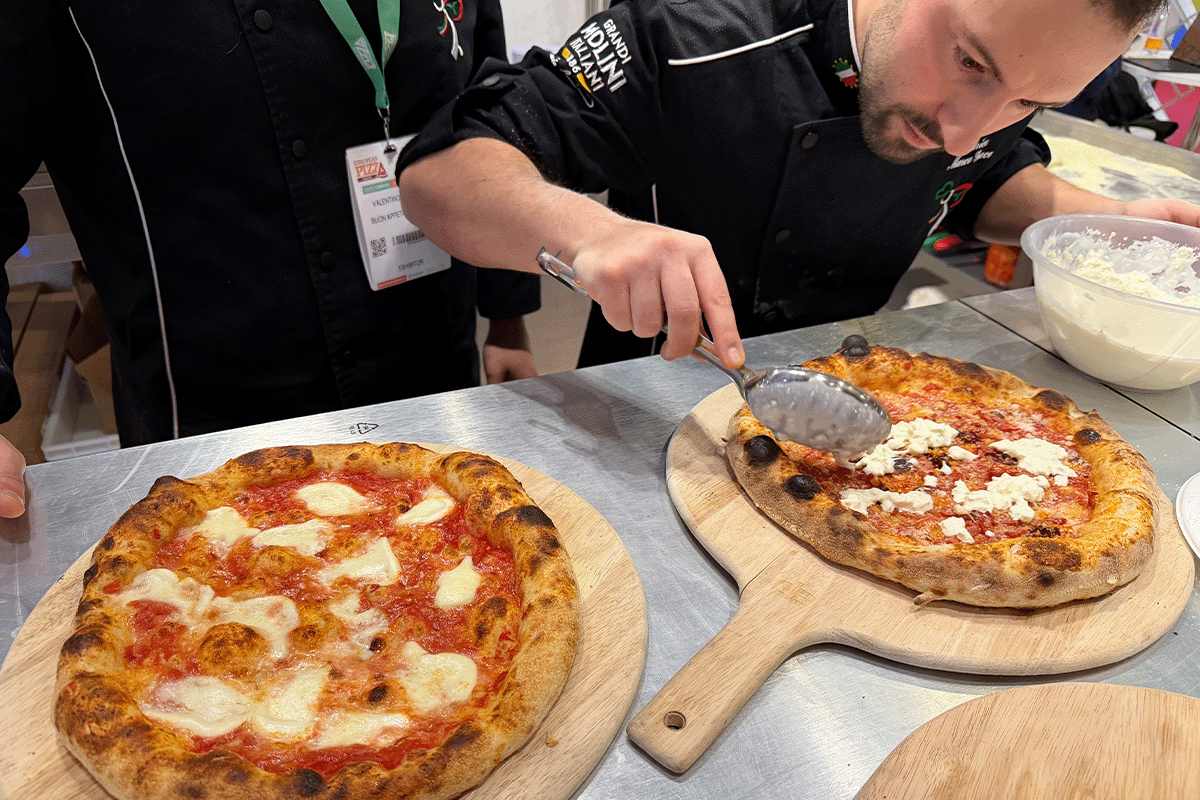
Cheese is obviously the heartbeat of pizza. How do you approach its use?
For me, it’s not just an ingredient – it is a storyteller. Growing up in southern Italy, in Sicily, I learned that cheese gives a dish depth, balance and identity. In pizza especially, it plays a crucial role, bringing saltiness, richness, and that essential umami element to complete the experience.
I pick cheeses that speak the language of authentic Italian tradition. From the creaminess of burrata, to the delicate sweetness of a high-quality Mozzarella di Bufala Campana, the structure and complexity of Parmigiano Reggiano and aged pecorino, right through to the bold, rich character of gorgonzola.
In both pasta dishes and pizza, cheese must always be selected and paired according to the other elements on the plate. Sometimes it’s interesting not to use cheese only in its grated form but to explore it through fondue-style preparations, creams or sauces, bringing innovation and modernity to a traditional dish while still respecting its roots.
Authenticity is everything in Italian cooking. How do you deliver this?
It starts with knowledge and respect for tradition – understanding how cheeses have historically been produced across different Italian regions and using them in harmony with seasonal, quality ingredients.
Guaranteeing authenticity today is not always easy. Demand is high, and the market is full of imitations, especially for iconic products such as Parmigiano Reggiano or Mozzarella di Bufala Campana. However, there are clear indicators that help identify the real thing. Italy’s most important cheeses are protected by official quality marks, often stamped directly onto the rind or clearly displayed on the packaging.
For example, Mozzarella di Bufala Campana DOP is protected by a specific consortium. It is one of the most counterfeited cheeses in the world, so it’s essential to look for the official logo – a sun-inspired symbol in the colours of the Italian flag with a buffalo head at its centre.
From a consumer perspective, are expectations around cheese changing?
Absolutely. People are more curious, informed and demanding than ever before. They want authenticity but are also open to innovation – cheeses with a clear provenance and a story, alongside new textures, pairings and modern interpretations.
There is a growing appreciation for artisanal Italian cheese, with curiosity about how it can fit into modern lifestyles and global flavour influences. My approach is always to honour tradition, while staying open to the natural evolution of contemporary taste.
In your experiences, which are the finest Italian cheeses?
They are as diverse as the regions they come from. In Sicily, you find intense, sun-driven flavours that pair beautifully with citrus and aromatic herbs. One of the island’s most iconic protected cheeses is Piacentino Ennese DOP – a unique sheep’s milk cheese made with saffron pistils and black peppercorns. Bold and savoury, it has a deep golden colour and beautiful saffron aroma.
In northern Italy, you discover aged cow’s milk cheeses and mountain varieties with deeper, more complex notes. In Emilia-Romagna, Parmigiano Reggiano DOP needs little introduction – one of the most famous and imitated cheeses in the world, with over a thousand years of history, yet only one true original.
In Sardinia, Pecorino Romano is produced – a fundamental ingredient in Italian cuisine and essential for iconic dishes such as carbonara, pesto and many others.
I truly believe that every Italian region has a signature cheese that reflects its biodiversity, landscape and animal husbandry. The finest ones are born where tradition and territory meet; where climate, history and culture shape unique dairy expressions. Whether it’s a burrata from Puglia or pecorino from Sardinia, great cheeses always tell the story of where they come from, bringing Italy to the world through flavour.
Italian food is enjoying a strong reputation in the UK at the moment. Is that something you’re seeing?
Without a doubt. There is a deep respect and genuine enthusiasm – especially now that Italian food culture has recently been recognised as Intangible Cultural Heritage of Humanity. Interest goes far beyond pizza and pasta, embracing regional specialities, artisanal products and authentic techniques.
People want to understand the stories behind dishes, the origins of ingredients, and the connection between food, culture and memory. This makes my work incredibly rewarding. Cooking becomes a form of cultural exchange – something I express through my kitchen, my private chef services and masterclasses, where I tell the story of Italian cuisine, its products and the traditions of a truly unique land.
For me, food is a language of connection. Every dish has the power to bring people together. My mission is always the same: to create food that not only tastes beautiful but evokes emotion, sparks memories and makes every experience unforgettable.
And while pairing cheese with food may seem simple, in reality it requires study, research and intention. Before creating a dish or a pizza, it’s essential to think carefully about balance. Nothing should be left to chance.
Take a classic pasta al pomodoro. Parmigiano Reggiano is essential but the final result depends just as much on the quality of the other ingredients – especially the tomato. A tomato passata like Cirio, beautifully balanced in sweetness and acidity, intense yet harmonious, allows the cheese to shine without overpowering the dish. It provides a clean, authentic base that respects tradition and enhances every element.
The same principle applies to pizza. Cheese may be the star but it needs equally strong supporting ingredients to truly stand out. A high-quality Cirio tomato base is the foundation of pizza, lasagna and pasta al pomodoro – a rich, reliable structure upon which deep, well-balanced flavours are built. When the raw materials are excellent, the dish speaks for itself.
I firmly believe that great dishes are born from great ingredients. That is where true cooking begins: in the conscious choice of products that tell a story, respect tradition and transform simplicity into excellence.
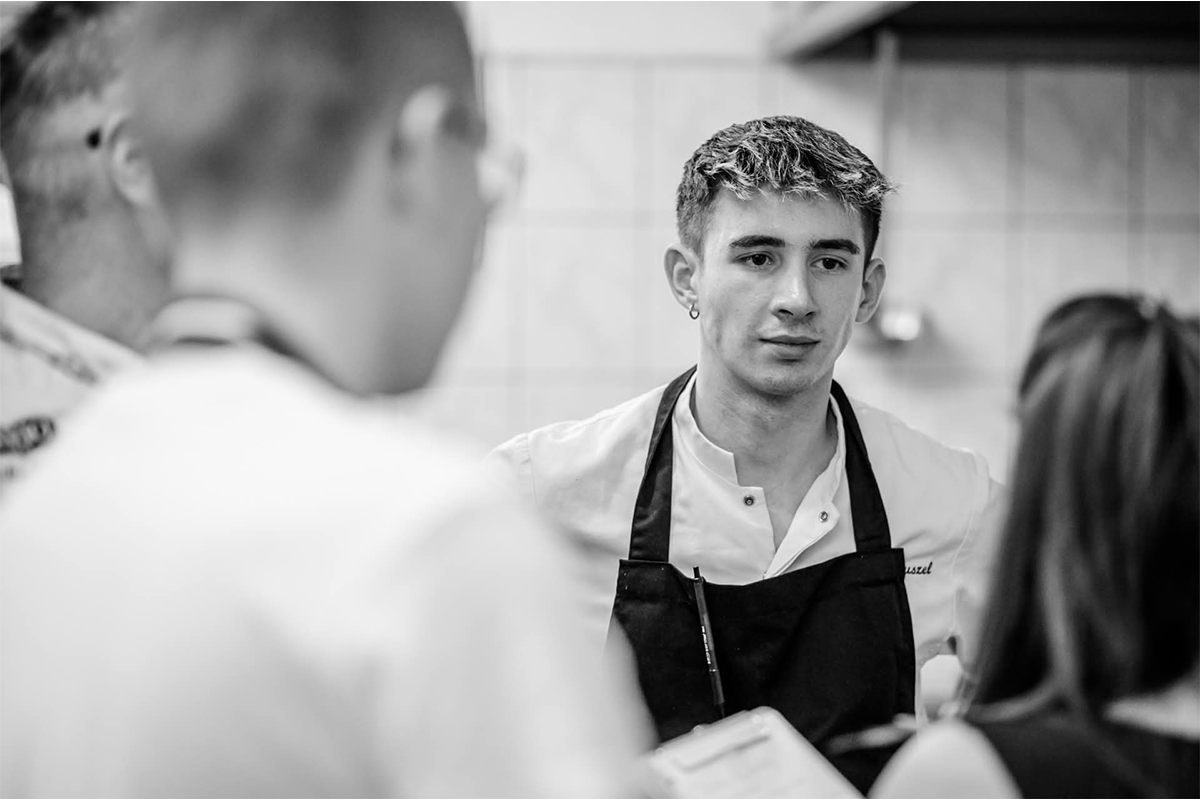
Andrea Ruszel was born in 2000 in the heart of Sicily. His father was a chef, while his mother worked in hospitality. By the age of 11, Andrea was helping in the family restaurant. He graduated from the ‘Federico II’ Hospitality Institute in Enna, eventually working at L’Albereta Relais & Chateaux under chef Fabio Abbattista. He moved to London in 2021 and was awarded ‘Best Upcoming Italian Chef 2024’ at an I Love Italian Food competition. Andrea’s Table is an independent project dedicated to private dining, culinary collaborations and personally created masterclasses. He also came second in the Best Pasta Chef Cirio Awards 2025 at the EPS. Check out andreastable.co.uk